
Quantum mechanics is a key part of physics that deals with tiny things like atoms and particles. It changed how we see the world, from tiny particles to huge stars. This field started in the early 1900s.
Quantum mechanics talks about how tiny particles like electrons and photons act. They don’t behave like big things we see every day. These particles follow different rules than what we’re used to.
One important idea in quantum mechanics is quantum superposition. It says a particle can be in many places at once until it’s looked at. This idea makes us question what reality really is.
Learning about quantum mechanics helps us make new tech. It’s key for making computers, phones, and finding new energy sources. Exploring quantum physics helps us understand the universe better and its future possibilities.
What is Quantum Physics?
Quantum physics, also known as quantum theory, studies matter and energy at the atomic and subatomic level. It started in the early 20th century with Max Planck and Albert Einstein’s discoveries.
Planck introduced the idea of energy quanta, showing that energy comes in packets, not as a continuous flow. Einstein’s work on the photoelectric effect proved that light can act as both waves and particles. This solidified the quantum theory principles.
Quantum physics is based on wave-particle duality and Planck’s constant. These ideas change how we see the physical world. They show that particles can be both waves and particles, and that the universe works differently than we thought.
“Quantum physics is a profound and challenging subject, one that forces us to rethink the very nature of reality.”
Exploring quantum particles reveals a world where classical physics doesn’t apply. Here, new rules govern matter and energy. This field is changing how we understand the universe and leading to new technologies.
The Weird World of Quantum Particles
Welcome to the strange and captivating realm of quantum particles! At the heart of quantum physics lies the concept of quantum superposition. This is where particles can exist in multiple states at once. It’s often shown through the famous thought experiment of Schrödinger’s cat.
Imagine a cat inside a box with a quantum device that can randomly release a deadly poison. According to quantum superposition, the cat is neither alive nor dead until the box is opened. This shows the quirks of the quantum world, where observing something can change its state.
But it gets even weirder. When a quantum particle is measured, its wave function, which describes all possible states, collapses into one definite state. This collapse is key to quantum mechanics and changes how we see reality.

Exploring the quantum realm shows us that classical physics doesn’t apply. Particles can act like both particles and waves, challenging our understanding of the world. This strange world of quantum particles is the key to unlocking the universe’s secrets.
Understanding Quantum Superposition
In the world of quantum mechanics, we find the fascinating concept of quantum superposition. This lets quantum particles, like electrons or photons, be in many states at once until they’re observed. Think of an electron being both a wave and a particle at the same time. That’s what quantum superposition is all about.
Quantum states are shown through probability waves. These waves tell us how likely it is to find a particle in a certain place or state. But, when we measure a quantum system, it suddenly becomes just one state. This is known as the measurement problem in quantum physics.

Quantum superposition makes us question our old ways of thinking. It shows that just by looking at something, we can change its state. This idea has led to deep discussions and has inspired many scientists and thinkers. They’re all trying to understand the big meaning behind this quantum phenomenon.
“Quantum physics is not only stranger than we think, it is stranger than we can think.” – Niels Bohr
As we explore more of the quantum world, quantum superposition keeps us amazed and curious. It’s pushing us to see the world in new ways and understand its deepest secrets.
The Role of Quantum Entanglement
Quantum entanglement is a fascinating phenomenon in quantum physics. Albert Einstein called it “spooky action at a distance.” It’s a key part of quantum mechanics that changes how we see the world.
When particles become entangled, they act as one system. The state of one particle instantly changes the other, even if they’re far apart. This strange behavior led to the EPR paradox, questioning local realism.
“Quantum entanglement is the key resource in quantum information processing and communication. It lies at the heart of the most profound aspects of quantum physics.”
Entanglement is not just interesting in quantum theory. It’s also crucial for quantum information. It’s essential for quantum computers and systems, like quantum cryptography and teleportation.
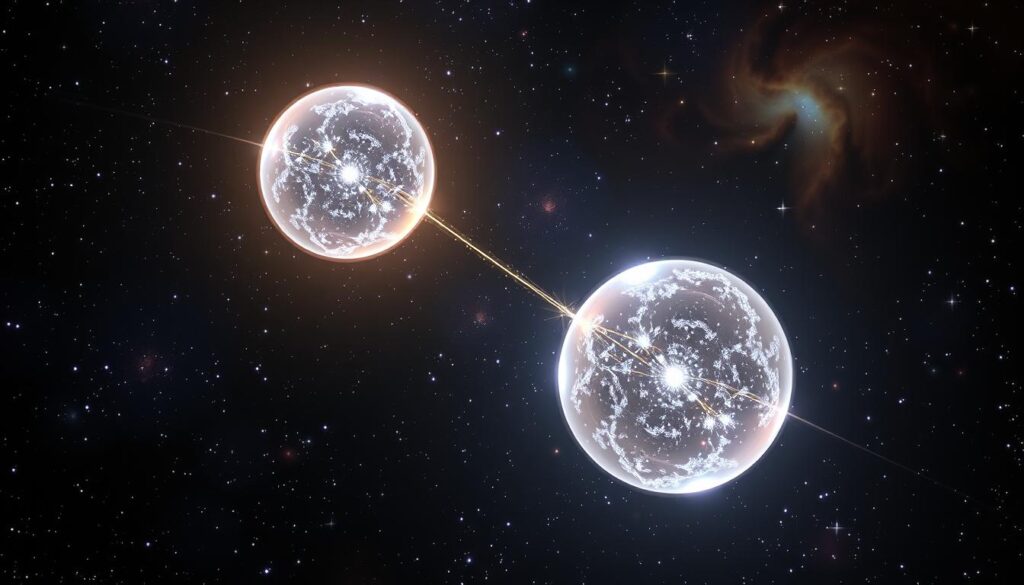
As we learn more about quantum entanglement, it opens new doors in science and tech. It’s changing how we handle and share information. The study of entanglement is exciting and always growing, pushing our understanding of reality.
Quantum Mechanics vs Classical Physics
At the heart of the debate between quantum mechanics and classical physics is determinism. Classical physics believes in a predictable universe. It says we can know exactly how particles and systems will behave. But, quantum mechanics brings in uncertainty, shaking this idea.
The uncertainty principle by Werner Heisenberg shows that knowing a particle’s position well means we can’t know its speed as well. This rule shows that some things in the quantum world are just too uncertain. It makes us question the idea of a perfectly predictable universe.
The wave function is key in quantum mechanics. It shows how particles can act like waves. This is different from classical physics, which sees particles as solid objects. The wave function tells us the chance of finding a particle in a certain state. This idea is new and challenges the old ways of thinking.
“Quantum mechanics is certainly imposing. But an inner voice tells me that it is not yet the real thing. The theory says a lot, but does not really bring us any closer to the secret of the ‘old one’. I, at any rate, am convinced that He is not playing at dice.”
– Albert Einstein
Quantum mechanics and classical physics show a big change in how we see the world. Classical physics works well for big things, but quantum mechanics changes the game for tiny particles. It opens up a new world for science to explore and discover.

Applications of Quantum Physics in Technology
Quantum physics is now a big deal in tech, not just in schools. It’s changing many fields with quantum computing, cryptography, and sensors. These new techs are based on quantum mechanics.
Quantum computing could make computers much faster. They can solve problems that old computers can’t. This is because quantum computers use special quantum particles.
Quantum cryptography is another cool use. It makes sure messages are safe and can’t be read by others. This is because of how quantum particles work.
“Quantum cryptography allows for the creation of unbreakable encryption, protecting our most sensitive information from hackers and eavesdroppers.”
Quantum sensors are also changing things. They can find tiny changes in things like gravity. This helps in many areas like medicine and space research.
Quantum physics is growing fast. Its techs are going to change how we do things. We’ll see new ways to process info, talk securely, and explore the world.
The Observer Effect in Quantum Mechanics
Quantum physics is a fascinating and complex field. It shows how just looking at tiny particles can change how they act. The double-slit experiment is a key example of this, showing that these particles can act like waves or particles.
In the double-slit experiment, electrons passing through two slits create an interference pattern, like waves. But, this pattern disappears when someone tries to see which slit the electron went through. This change, called wave function collapse, shows that watching the particles can change their nature.
This idea has sparked debates about the role of consciousness in quantum mechanics. Some think our consciousness affects the results of quantum experiments. Others disagree. The measurement problem in quantum mechanics is still being studied and discussed, with different views trying to make sense of it.
The observer effect in quantum mechanics challenges our old views of the world. It makes us question the difference between the observer and the observed. As we learn more about quantum mechanics, the question of how consciousness affects reality remains intriguing and important.
Common Misconceptions About Quantum Physics
Quantum physics explores the tiny world of subatomic particles. It’s often mixed up with quantum mysticism or pseudoscience. But, these views are not what quantum physics really is. It’s a complex and interesting field that challenges our common sense about the world.
Many think quantum physics lets us control reality with our minds or through meditation. But, the strange ways quantum particles act are based on solid science and experiments. They show us the basic parts of our universe, not magic or supernatural powers.
“Quantum physics is not magic; it’s the best description we have of the natural world at the atomic and subatomic level.”
Some believe quantum physics supports any pseudoscience, like alternative healing or paranormal claims. But, the quantum world is weird, and scientists have a clear way to understand and use it. Misusing quantum ideas harms the field’s real value and potential.
As we delve into quantum mysticism and interpretations of quantum mechanics, we must keep science and speculation separate. By understanding quantum physics correctly, we can discover its true wonders. This will lead to new discoveries in science and technology.
The Future of Quantum Physics
Quantum physics is a fascinating field that keeps leading to new discoveries. Scientists are looking into theories like quantum field theory and string theory. These ideas could connect quantum mechanics and general relativity, two key areas of physics.
Quantum field theory helps us understand tiny particles better. It’s giving us new insights into the universe’s structure. This could lead to big advances in quantum gravity. String theory, on the other hand, aims to unify all forces in nature. It’s expanding our view of the universe.
Finding quantum gravity is a major goal in quantum physics. It tries to merge quantum mechanics and general relativity. This quest could reveal how the universe began and lead to new technologies that change our lives.